
1. Overview and Historical Context
Tobacco sheet, also known as reconstituted tobacco, is a restructured tobacco material produced using tobacco lamina fragments, tobacco dust, and tobacco stems as raw materials. Its production originated in the 1950s within the US cigar industry, initially aiming to improve the burning characteristics of cigar wrappers and recycle leftover materials.
With the growing demand in the cigarette industry for low-tar products and efficient raw material utilization, tobacco sheet technology developed rapidly. Since the 1960s, it has been applied on a large scale globally, with consumption steadily increasing.
2. Evolution of Primary Manufacturing Methods
The primary manufacturing methods for tobacco sheets are the cylinder process, the slurry process, and the paper-making process:
Cylinder Process: Features simple equipment and low cost, but the resulting sheets have poor strength, low filling power, and high tar content.
Slurry Process: Sheet performance is intermediate between the cylinder and paper-making processes. However, it relies mainly on physical processing, making chemical component regulation difficult.
Paper-Making Process: Through steps like extraction, separation, concentration, and coating, this method enables precise control over tobacco components and has gradually become the dominant technology. Domestically, the cylinder and slurry processes were predominant initially. In recent years, due to the advantages of the paper-making process in quality enhancement and tar/harm reduction, it has progressively replaced the former two methods.
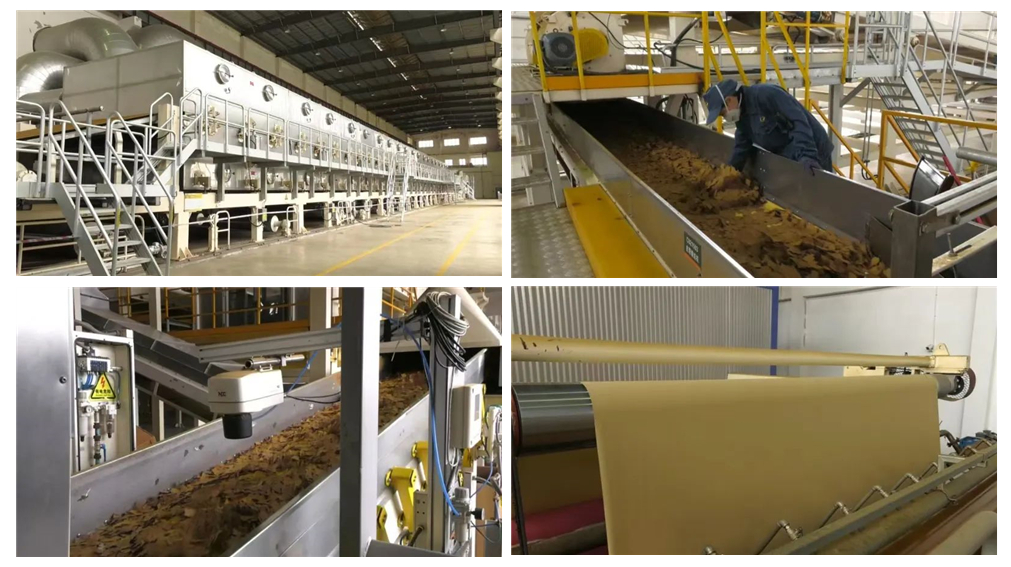
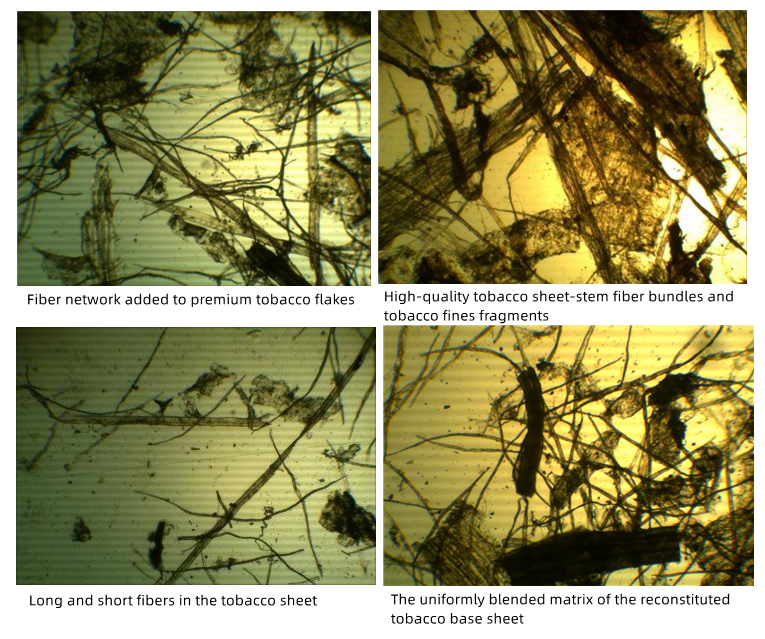
3. Structure and Fundamental Process Rationale for Paper-Making Process Tobacco SheetsSheets produced via the paper-making process can be conceptualized as “tobacco paper” where added high-quality fibers form the “skeleton” and tobacco stems/dust act as the “filler material”. Structural analysis indicates:
① Critical Role of Added Fibers: A combination of softwood pulp (long fibers) and hemp pulp (short fibers) is used. Long fibers enhance strength, while short fibers provide filling and retention aid functions. The uniformity of mixing directly impacts sheet quality.
② Principle of Stem Treatment: Tobacco stem fibers are of poor quality and should not be excessively fibrillated. The focus should be on cutting and defibering them into fiber bundles, avoiding deep refining which increases fines and adversely affects sheet strength and porosity.
③ Coating Solution Requirements: The coating solution is prepared via extraction and concentration, requiring precise control of components like nicotine to optimize the sheet’s inherent quality.

4.Comprehensive Production Process of the Paper-Making Method
The paper-making process comprises six main operational sections:
① Raw Material Preparation: Utilizing primarily unburnt or initially roasted waste tobacco leaves.
② Extraction and Pulping:
Stems and dust are extracted with water; tobacco lamina is extracted with ethanol (replacing caustic soda to reduce pollution).
The extracted residue is mixed with added fibers, then undergoes dewatering and beating to form the stock.
③ Sheet Forming: The stock is formed into a base sheet via the headbox, wire section, press section, and dryer section. The base sheet is then disintegrated, flavored, and dried.
④ Extract Concentration: The extract is evaporated and concentrated into a coating solution. The concentrated black liquor from stems/dust undergoes refining to extract nicotine, reducing harmful components in the final sheet.
⑤ Refining and Concentration: The concentrated black liquor from stems/dust undergoes separation, clarification, and further concentration using ethanol, yielding a tobacco extract product with high solid content (e.g., 65%).
⑥ Packing and Baling: The dried sheets are flavored (optionally), stored for permeation and equilibration, pre-pressed, baled, and packaged for storage.
5.Technical Advantages and Application Value
① Quality Enhancement: Paper-making process sheets exhibit low density, high filling power, allow for chemical component adjustment, reduce tar delivery, improve combustibility, facilitate flavoring/additive application, and enhance blending flexibility.
② Environmental and Economic Benefits: Using 10,000 tons of these sheets equates to saving approximately 70,000 mu (about 4,667 hectares) of land required for tobacco cultivation, significantly improving raw material utilization efficiency and aligning with circular economy principles.
③ Cleaner Production: Employs closed counter-current washing, water recycling (achieving 87% reuse rate), purification and reuse of concentrated black liquor, and comprehensive utilization of boiler ash, resulting in low pollutant discharge.
④ Industrial Application: Following trials in Shantou and Hangzhou in the 1990s, the technology was expanded nationwide. Currently, the average inclusion rate in mainstream cigarette brands exceeds 20%. Online concentration meters (e.g., MPRE-Scan) are used to monitor tobacco juice concentration, ensuring production stability.