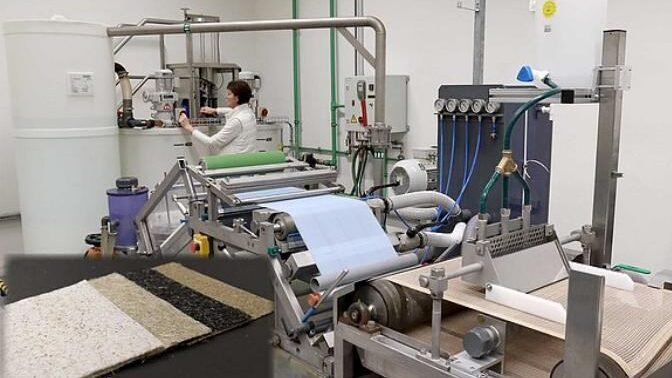
Toilet paper is made by forming cellulose fibers into a thin tissue sheet, removing water, and winding the sheet into large parent rolls. A separate converting stage gives the paper its consumer format: plies, embossed patterns where required, tear lines, roll size and packaging.
The important distinction is between making the paper itself and turning that paper into the rolls sold to customers. Understanding both stages makes factory videos, product descriptions and production proposals much easier to interpret.
The Toilet Paper Making Process at a Glance
For a conventional dry-creped route, the sequence is:
Prepared pulp → Stock preparation → Sheet forming → Pressing and drying → Creping → Parent rolls → Converting → Packaging
The material changes form along the way:
| Stage | What enters | What leaves |
|---|---|---|
| Stock preparation | Prepared pulp and process water | A controlled fiber suspension |
| Forming and pressing | Dilute stock | A continuous wet sheet with some water removed |
| Drying and creping | Wet tissue web | Dried, creped tissue base paper |
| Reeling | Continuous tissue sheet | Parent rolls for storage or converting |
| Converting and packing | Parent rolls and packaging materials | Finished toilet rolls ready for distribution |
Pulp production may take place at a different site from tissue production. Essity's published toilet-tissue life-cycle description, for example, separates upstream pulp manufacture from tissue production, converting and packaging. Essity: toilet tissue production stages
1. Start with the Appropriate Pulp
The fiber supply can come from prepared wood pulp, bamboo pulp or a suitable recovered-fiber route. It must be supplied in a condition that matches the mill's stock preparation and the tissue being made. Fiber origin is only part of the specification; pulp processing and cleanliness also matter.
A mill that buys market pulp starts with material already processed into pulp upstream. It does not need to begin every production batch by cutting trees or cooking wood chips. A producer using recovered paper needs the appropriate recovery and cleaning operations, while a converter buying parent rolls starts after the paper has already been formed and dried.
This explains why two videos titled “how toilet paper is made” may show very different factories. One may show pulp preparation and papermaking; another may show only finished-roll converting. Essity's own site descriptions include a tissue mill supplying other converting sites and a separate operation that receives paper for converting. Essity: examples of different manufacturing-site roles
2. Prepare the Stock
At a mill using dried pulp, a pulper separates the pulp into water to make a fiber suspension. The stock is then prepared to suit the intended sheet. Depending on the furnish and installed system, this includes cleaning, screening, blending and refining.
The aim is to supply consistent stock to the forming section. This watery suspension needs to flow and distribute evenly; it is not yet a sheet of paper. Valmet's overview places stock preparation before tissue production and distinguishes these operations from downstream converting. Valmet: the tissue-production sequence
3. Form a Continuous Tissue Sheet
The headbox delivers the prepared stock across the working width. In a crescent-former arrangement, the stock enters between a forming wire and a felt around the forming roll. Water removal allows the fibers to form a continuous wet web, which the felt carries onward.
This is the point where a flowing suspension becomes a recognizable sheet. The sheet is still wet and needs support as it moves through the next stages. The headbox, forming wire and felt perform different jobs within that transition.
4. Remove Water by Pressing and Drying
Pressing removes part of the water mechanically. In the conventional dry-creped process described here, the sheet is transferred to a heated Yankee cylinder, and a hood works with the cylinder to remove further moisture.
Pressing and drying are separate operations. The first removes water through mechanical action; the second supplies heat for evaporation. Their condition affects what reaches the creping and reeling stages.
Other tissue processes, including through-air drying, use different drying arrangements. Valmet distinguishes conventional dry-crepe, hybrid and through-air-drying concepts within its tissue portfolio. Valmet: tissue process concepts
5. Crepe the Sheet and Wind Parent Rolls
A creping blade removes the sheet from the Yankee surface and develops the creped structure. The blade geometry and its interaction with the cylinder influence the resulting tissue. Creping is a papermaking operation; it is separate from the visible embossed patterns that may be added later. ANDRITZ: the role of tissue creping
The reel then collects the paper into large parent rolls, also called mother rolls or jumbo rolls in commercial discussions. At this stage, the mill has made tissue base paper. The rolls can move to converting at the same factory or be supplied to another site.
6. Convert the Paper into Toilet Rolls
Converting establishes the format that the customer buys. Depending on the product, the operations include unwinding parent rolls, bringing plies together, embossing, perforating and rewinding. A cored product is wound around a paperboard core. Long wound rolls, often called logs, are cut into individual retail-roll widths before packing.
The exact sequence and equipment vary with the product. Embossing, ply bonding and a cardboard core should not be assumed to appear in every toilet roll. Valmet describes converting as the transformation of parent tissue reels into finished hygiene products, with separate equipment for roll products, folded products and packaging. Valmet: tissue converting and packaging
For one example of the equipment functions involved, Valmet's published converting-line specification identifies a rewinder, embosser, perforation settings and a log saw. These are converting functions, rather than operations that turn pulp into paper. Valmet: an example of roll-converting functions
7. Check and Pack the Finished Product
For a finished-roll inspection, a practical checklist can include roll width, diameter, sheet count or length, ply count, perforation behavior, appearance and packaging identification. The agreed customer specification determines the acceptance criteria.
Keep base-paper records separate from finished-pack checks. A parent roll may meet its paper specification while a later converting or packing issue affects the saleable product. Identifying the stage makes a quality discussion more useful than treating every defect as a papermaking problem.
Questions About How Tissue Paper Is Made
Are creping and embossing the same thing?
Creping takes place during the papermaking route described above, at the Yankee surface. Embossing is a separate operation that can add a pattern during converting. Seeing a pattern on a finished roll does not identify the complete process used to make its base paper.
Does every factory start with raw wood?
No. Some sites make pulp, some buy prepared pulp to make tissue, and others buy parent rolls to convert. The starting material determines which stages you will see at that factory.
Is the parent roll already the finished consumer product?
It is the output of base-paper production. Consumer roll dimensions, ply arrangement, perforation and packaging are established during the subsequent converting operations.
For a closer look at the equipment used between prepared stock and the parent roll, see Bannor's crescent-former tissue production configuration.